
St. Clair VINELink Coverage
Illinois uses Illinois VINE, also called Illinois Automated Victim Notification, through VINELink’s Illinois service. It is free and operates continuously. Custody data, however, comes from participating agencies. A live result can include a currently held person or someone recently reported as released.
The available research does not establish a definitive coverage roster proving that every St. Clair County Jail and IDOC event always reaches VINE. Confirm the contributing agency on the matched record. Participation can differ, a feed can be offline, and some records may be blocked from disclosure. VINELink support is available at 1-866-277-7477 at all times.
A VINE event relates to the agency and custody episode displayed. It does not prove that the person is outside every local, state, federal, or immigration system. A county jail release could be a transfer. An IDOC prison departure could begin mandatory supervised release, which is continued state legal supervision in the community.
Search St. Clair VINELink Names
Use the direct Illinois person-search route when checking one known individual. Start with the most reliable identifier available. Similar names can produce multiple records, and a name alone is not enough to choose among them.
- Select “Search for Someone” in the Illinois service.
- Enter the person’s name or available offender or booking identifier.
- Compare the returned matches rather than opening the first similar name.
- Open the likely record and confirm the reporting agency.
- Read the exact custody status and its associated date.
- Save the source, observation time, event wording, and identifier.
If no result appears, try a spelling variation or identifier. Then contact the source facility. Nonparticipation, an offline feed, a nondisclosable record, or a fully historical event can all lead to no match. Absence must not be labeled as release.
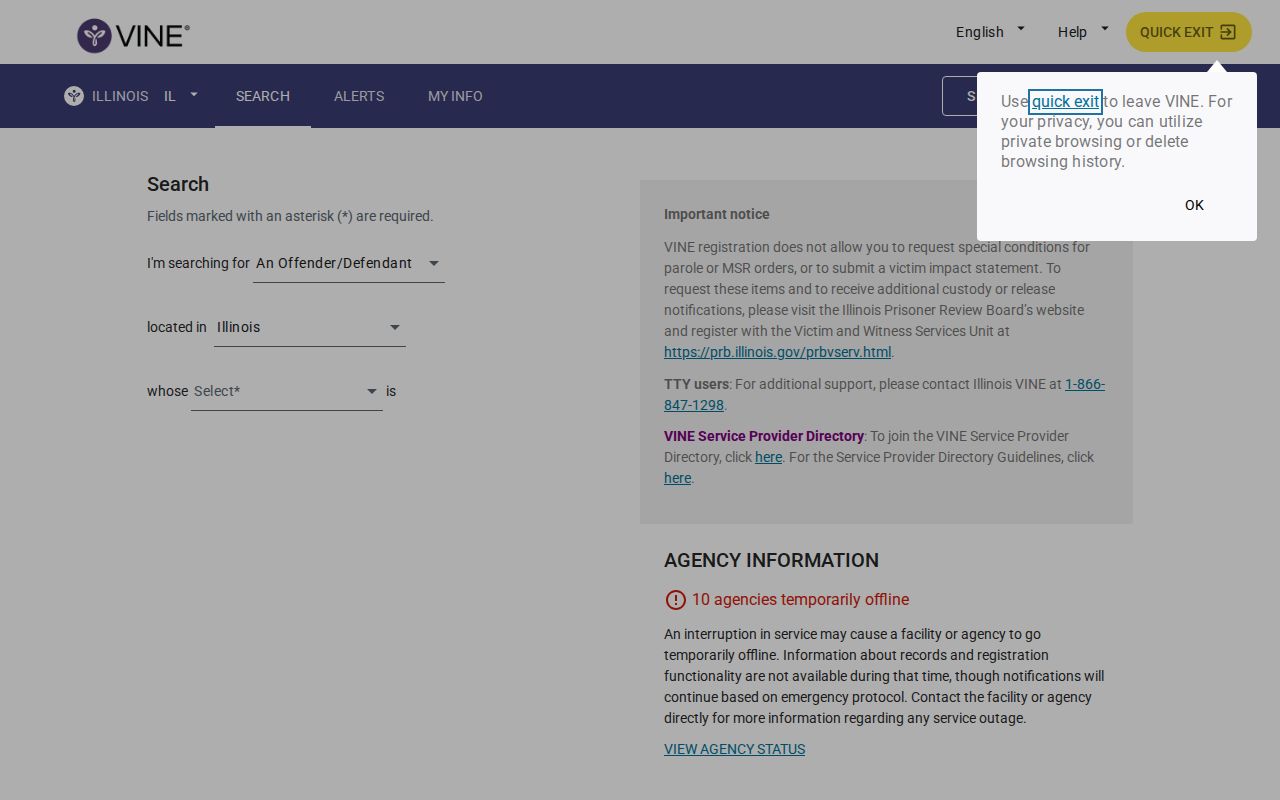
The Illinois person-search screen is the correct state route. Verify the reporting agency because St. Clair County, IDOC, and another Illinois custodian may describe distinct custody episodes.
Read St. Clair VINE Results
VINELink labels and options can vary with the agency feed. Publish only what the live record actually says. The research did not verify a universal St. Clair County result format or local release-reason field.
| Result element | How to use it |
|---|---|
| Name or identifier | Helps distinguish the intended person from similar matches. |
| Reporting agency | Identifies the custodian that supplied the event. |
| Custody status | States the agency-fed condition at the observed time. |
| Associated date | Places the status or change in time. |
| Notification option | Shows which future events can trigger an alert. |
| Facility or location, if shown | Points to the agency to contact for confirmation. |
“Released” is not a lifetime status. It is a recent event supplied for a custody episode. Record the exact label instead of changing it to “free.” If transfer language appears, follow the receiving custodian. If an IDOC result points to parole or mandatory supervised release, prison confinement ended but supervision did not.
Register St. Clair Release Alerts
Start notification registration only after confirming the correct person and reporting agency. Options depend on what the record and jurisdiction enable. Illinois VINELink may offer phone, email, SMS or text, TTY, or in-app delivery.
- Select notifications from the correct individual’s record.
- Choose the custody event offered by that agency.
- Select a delivery method and enter the requested contact details.
- Choose a language when the service offers that setting.
- Add a second delivery channel to reduce the risk of a missed alert.
- Create and confirm the four-digit PIN, then review and save.
The four-digit PIN acknowledges phone or TTY alerts and helps manage registration. An optional verified VINELink account may also use a separate six-character code sent by text or email. These codes are not interchangeable. One is tied to alert acknowledgment; the other confirms account contact information.
Keep registration details private. Revisit them when a phone number or email address changes. An alert is only as timely and precise as the source feed. It is valuable notice, but the underlying agency record remains the stronger proof.
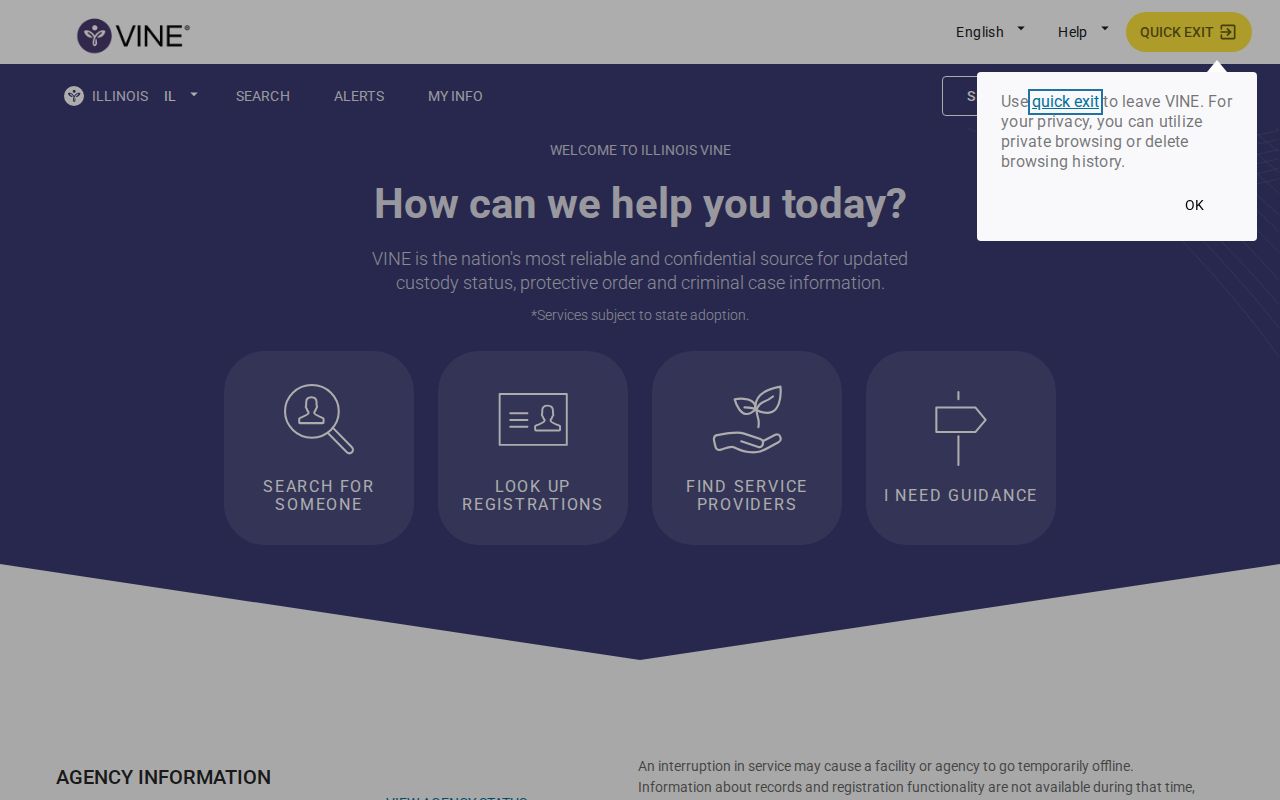
The state landing page leads to search and notification tools. Use the matched record’s options rather than assuming every agency offers each event or delivery channel.
Confirm St. Clair VINE Releases
A notification should begin verification, not end it. Note the reporting agency, message time, event wording, and event date. Then contact the agency that supplied the update. Acknowledging a phone notice with a PIN proves receipt of the message, not the full legal meaning of the custody change.
| Reporting path | Best confirmation | Key limit |
|---|---|---|
| St. Clair County Jail | Sheriff custody history and court docket | Roster is current-only |
| IDOC prison | IDOC status, release/discharge block, and records office | Release to MSR is not final discharge |
| Federal prison | BOP inmate locator | VINELink is not the federal locator |
| Immigration custody | ICE Online Detainee Locator and ERO | Current locator, not release history |
For a county event, call the St. Clair County Jail at 618-456-7606. Ask whether the person is still physically held and, when releasable, what date, time, and disposition ended the custody episode. Check the Circuit Clerk docket for the related order. If precision matters, request the sheriff’s custody chronology.
Check IDOC After St. Clair
A person transferred from the county jail to the Illinois Department of Corrections has not been released from custody. Search the IDOC offender search by last name, IDOC number, or birthdate. Read the status, location, admission information, Last Paroled Date, Projected Discharge Date, and each sentence count.
An IDOC record can mark one count “Sentence Discharged?: YES” while another remains active. That single flag does not prove person-level discharge. Likewise, a no-match result may reflect a search error or a completed and removed record. IDOC itself notes that discharge can explain absence. Use IDOC’s Public Information Office or FOIA route for historical confirmation.
If the IDOC status indicates parole or mandatory supervised release, record that exact term. Parole and MSR are community supervision after prison, while final discharge ends the state supervision component. VINELink can notify about an event, but IDOC and the Prisoner Review Board control the relevant state records.
Illinois VINE Notification Layer
Illinois VINE is a notification layer built on agency data. That design is useful because a registered person can receive a change without repeatedly checking a roster. It also explains why the source agency matters. VINE does not create the jail’s custody entry, the court’s release order, or IDOC’s discharge record.
- Custody status
- The condition reported by the contributing agency at the observation time.
- Release event
- The reported end of that agency’s custody episode, which may require transfer checks.
- Transfer
- A move to another custodian, not a community release.
- Mandatory supervised release
- Community supervision that follows Illinois prison confinement.
- Final discharge
- The end of the supervision component as supported by state records.
The complete named-person workflow, including sheriff, court, IDOC, federal, immigration, and records-request routes, appears on the St. Clair County released inmates home page. VINELink remains the best fit when the main goal is watching one participating-agency record and receiving a status alert.
Note: Save the reporting agency and exact status language because the word “released” does not rule out transfer or ongoing supervision.
Preserve St. Clair Alert Evidence
Identity checks matter even when a result looks close. Compare the agency, booking or offender identifier, and any non-sensitive details the interface provides. Do not rely on a photograph or common name alone. If two candidates remain possible, contact the custodian with the identifiers and date range. A mistaken match can attach the right event to the wrong person.
A second delivery channel helps because voicemail can fill, numbers can change, and email can be filtered. Registration does not alter custody. It only requests notice of an enabled event. If an expected alert never arrives, search again and call the agency. Do not infer that custody continued merely because no message came.
Keep the alert time apart from the custody-event time. A message may arrive after the change, and the court order may carry a third date. Writing all three as one release date removes useful evidence. Record them separately and let the custodian explain a conflict.
Public Record Search
Sponsored Results