
SWICC Release and Transfer Paths
Movement out of SWICC is not automatically a release. IDOC may transfer a person to another state institution while the sentence continues. A person who leaves prison for mandatory supervised release, often called MSR, has ended confinement but remains under IDOC legal supervision. Final discharge is a later event that ends that supervision component.
The IDOC profile can show Parent Institution, Offender Status, Location, Admission Date, Last Paroled Date, Projected Discharge Date, and sentence information. Read Status and Location together. Then inspect every sentence count because “Sentence Discharged?: YES” on one count does not prove that all counts have ended.
| SWICC departure | Meaning |
|---|---|
| IDOC transfer | Confinement continues at another institution |
| Release to MSR | Prison confinement ends while state supervision continues |
| Final discharge | IDOC legal supervision ends |
Confirm a SWICC Release
Open the official IDOC Individual in Custody Search. Search by IDOC number when possible, or use last name or birthdate. Common names require care. Compare the IDOC number and available identifiers before accepting a result.
- Find the correct IDOC record and read Offender Status with Location.
- Review Admission/Release/Discharge Information, including Last Paroled Date and Projected Discharge Date.
- Inspect every sentencing block and each count-specific discharge flag.
- Distinguish a transfer, MSR start, and final discharge in notes.
- Use IDOC Public Information or FOIA when the public result is missing or historical proof is needed.
IDOC states that a no-match result may occur after a sentence or parole has been completed and discharged. Therefore, no match does not prove that the person was never in IDOC or supply a release date. The St. Clair County release-record overview shows how to compare state and county sources.
SWICC Release Records Contact
Southwestern Illinois Correctional Center is at 950 Kingshighway Street, East St. Louis, Illinois 62203. The facility telephone number is 618-394-2200. Individual release verification remains an IDOC records function, even though the prison is physically in St. Clair County.
Facility and records
Southwestern Illinois Correctional Center
950 Kingshighway Street
East St. Louis, IL 62203
618-394-2200
IDOC FOIA Officer
1301 Concordia Court, PO Box 19277
Springfield, IL 62794-9277
DOC.FOIARequest@illinois.gov
217-558-2200, extension 4166
A focused IDOC request can seek the public portions of admission, parole or release, projected discharge, final discharge, and maintained photographs. Internal master-record material may be exempt or redacted. Request existing records and exact fields rather than asking staff to compute a new date or legal conclusion.
SWICC Prison Record Context
IDOC classifies SWICC as a minimum-security adult male institution. The official facility material describes a treatment-community and reentry focus. The institution opened in August 1995. As of June 30, 2024, the official page reported 507 people and operational capacity of 733. Those figures are dated facility context, not a current population or proof about one individual.
Programming is also not release evidence. The treatment focus may help someone understand the institution, but it cannot establish that a named person completed a program, moved to MSR, or discharged. Only the individual's IDOC record can support those conclusions.
SWICC Projected Discharge Field
The exact public IDOC label is “Projected Discharge Date.” It is an administrative projection, not a guaranteed gate appointment. Sentence credit, pre-sentence credit, concurrent or consecutive terms, disciplinary credit loss or restoration, court corrections, and statutory rules may change the calculation. A profile may display “INELIGIBLE” instead of a date.
Last Paroled Date can mark a move from prison into a supervised phase, but it should be read with the current status. Final discharge may occur much later. Record each date with its label instead of renaming all dates “release date.” That precision is especially important for SWICC because prison exit and end of IDOC jurisdiction are separate events.
SWICC and County Jail Differences
SWICC and the St. Clair County Jail are in the same county but belong to different systems. The Belleville jail is operated by the sheriff and its current roster does not report IDOC status. SWICC is operated by IDOC, and the county sheriff cannot supply the prison admission or discharge record.
- County release
- An event ending a county-jail custody episode.
- MSR
- Mandatory supervised release, a supervised phase after prison confinement.
- Projected discharge
- IDOC's calculated future end point, subject to change.
- Final discharge
- The end of the state supervision component.
This distinction reflects St. Clair County's distinctive mix of an older county jail and a state prison opened in the 1990s. Geography alone does not identify the custodian.
SWICC Sentence Record Reading
IDOC sentencing blocks include the mittimus or case, offense class, count, offense, custody date, imposed sentence, county, and a count-specific discharge flag. Review every block. One discharged count can coexist with another active term, and concurrent or consecutive structure can affect the overall calculation. Parent Institution also should not be treated as a guaranteed statement of the exact bed location.
The public profile is strong evidence of what IDOC currently displays, but it is not a complete lifetime archive. Save the source, access time, IDOC number, and exact labels. If a former record is no longer returned, contact IDOC Public Information at 217-558-2200 or submit a focused FOIA request for admission, release or parole, and final-discharge history.
SWICC Release Notifications
Illinois VINELink can supplement an IDOC search for a specific person and may offer notification registration for status changes. Select Illinois, search by the available name or identifier, confirm the contributing agency, and open the correct record. A notification reflects the data supplied by that participating agency. It is not stronger than IDOC's maintained record.
A VINE release alert may mark the end of a reported custody episode without explaining whether another agency immediately assumed custody. Record the message time, contributing agency, event wording, and identifier, then verify the event with IDOC. VINELink does not replace BOP or ICE tools for federal or immigration custody.
SWICC Record Request Timing
IDOC states a five-working-day response period for noncommercial FOIA requests, with a possible five-day extension after written notice. Its published copying framework makes the first fifty black-and-white letter or legal pages free, followed by fifteen cents per page, while actual media costs can apply. These rules do not promise release of exempt master-record content.
Ask for electronic records in their maintained format and give a useful date range. Distinguish projected dates from actual events in the request. If the response gives only a projected discharge date, follow up for the actual parole or release entry and final-discharge record. If a field is redacted, retain the stated exemption and review instructions rather than guessing what the hidden content says.
SWICC Reentry Program Limits
The official treatment-community and reentry description is meaningful facility context. It may help families locate program or transition information. It does not establish that a named person enrolled, completed treatment, earned credit, or qualified for a particular date. Those claims require the individual's IDOC record or an authorized confirmation.
St. Clair County also identifies community navigation and treatment resources through its Mental Health Board and Offender Success initiative. Such services may help with identification, transportation, treatment, family coordination, and supervision navigation after release. Participation is not proof of release, and a facility's program identity is not a substitute for Offender Status, Last Paroled Date, or final discharge.
SWICC Court and IDOC Records
A St. Clair County court docket may document the sentence or mittimus that sent a person into IDOC, but IDOC controls the later prison movement, MSR start, and discharge record. Court authorization and correctional implementation are separate. If a judge amends a sentence or credit calculation, the court order can explain why an IDOC date later changes, but the current IDOC profile shows what the department is administering.
Use the Circuit Clerk process for local court copies because the clerk expressly says ordinary county FOIA does not govern court records. Use IDOC FOIA for department records. Provide the case number and IDOC number when available so each office can locate the correct record without being asked to create a new report.
SWICC Federal Custody Boundary
SWICC is not a federal prison. A federal defendant in the Southern District of Illinois may be held through U.S. Marshals arrangements, sometimes outside St. Clair County. The Marshals Service has no public historical release locator identified in the research. If the person later enters BOP custody, use the BOP locator and read its Location and Release Date together.
“Not in BOP Custody” does not negate state or local custody, and an IDOC no-match does not establish federal release. Classify the governing system first. The physical presence of a state prison in East St. Louis does not give IDOC authority over a federal sentence, just as the county jail roster cannot report an IDOC discharge.
Official SWICC Facility Source
IDOC's official SWICC page supplies the facility classification and dated institutional context.
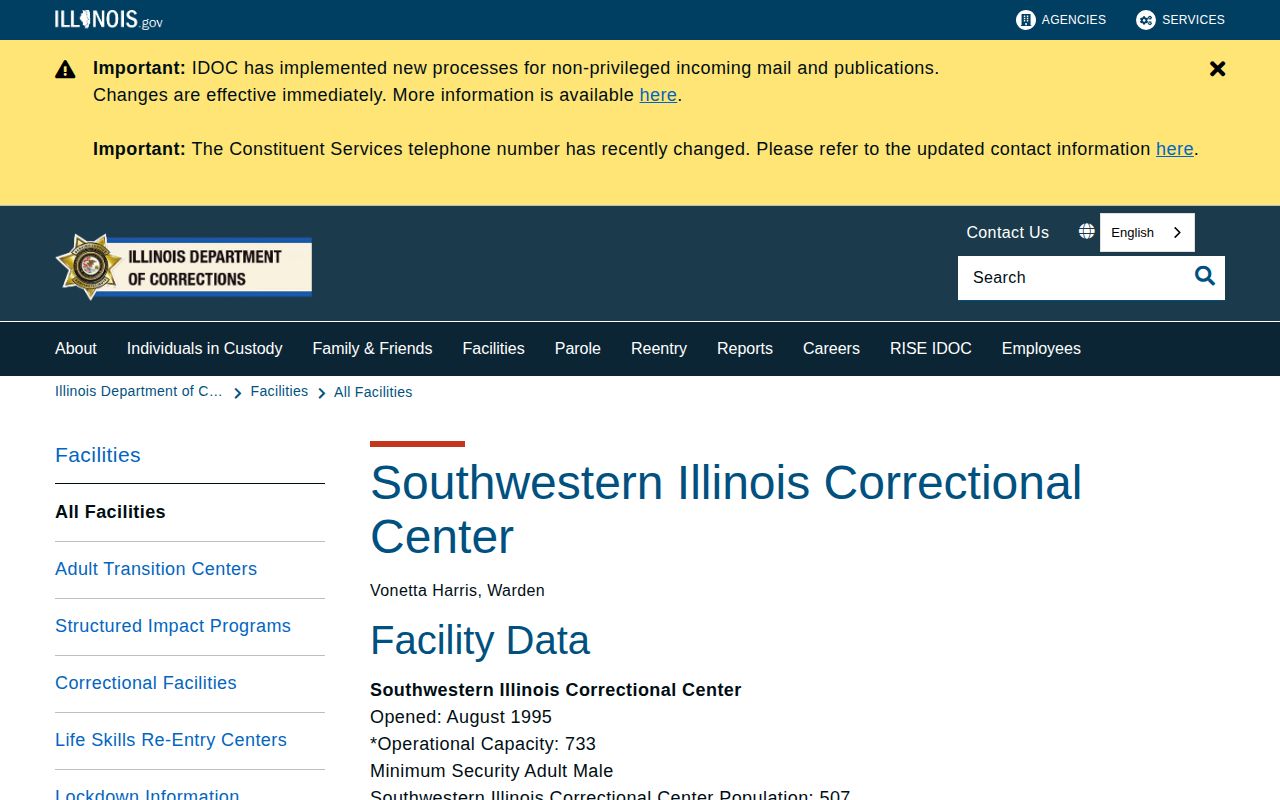
The facility page describes the institution. A named person's status still must be verified in the IDOC offender record.