
Parole vs Probation in St. Clair County
Probation comes from a criminal court judgment. St. Clair County's 20th Judicial Circuit Court Services and Probation Department administers local probation. Parole and mandatory supervised release, often shortened to MSR, follow an IDOC prison sentence. IDOC supervises those cases while the Prisoner Review Board sets conditions and handles functions such as revocation and final discharge. Pretrial supervision is different again: it applies while a criminal case remains pending.
| Status | Who orders it | Where to verify |
|---|---|---|
| Probation | St. Clair County court | Circuit Clerk docket, then Adult Probation |
| Pretrial supervision | Court before disposition | Court docket and statewide pretrial team |
| Parole or MSR | State-law release framework and PRB functions | IDOC record and PRB records |
These records answer different questions. None alone supplies the exact time a person physically left the St. Clair County Jail.
- Probation
- Court-ordered community supervision, often imposed instead of or after confinement.
- Parole
- Conditional community release used for eligible prison cases, including legacy and youthful-parole routes.
- MSR
- Mandatory supervised release that follows many modern Illinois prison sentences.
- Discharge
- The formal end of supervision or of a sentence, not merely release through a prison gate.
How to Verify St. Clair County Post-Release Supervision
Start with the legal source that created the status. Illinois has no verified public statewide database that names every parolee or supervising officer, and St. Clair County publishes no complete probation-absconder list. A careful check uses several records without treating silence as proof.
- Check the St. Clair County Circuit Clerk docket for a probation, pretrial-release, sentence, warrant, or discharge order.
- For ordinary county probation, contact Adult Probation when entitled to the information. Do not use IDOC for this status.
- For a former state prisoner, open the IDOC offender search. Read Offender Status, Location, Last Paroled Date, and sentence-discharge fields together.
- Check relevant Prisoner Review Board schedules or decisions only for the proceeding that applies.
- Confirm uncertain state status with IDOC or a focused records request.
A Last Paroled Date shows a transition from prison. It does not establish final discharge. Likewise, a probation order does not say when jail staff completed release processing. The St. Clair County released-inmate search path explains how to pair supervision evidence with custody history.
St. Clair Adult Probation Office
Local geography helps prevent a common records error. Adult probation, statewide pretrial services, and IDOC parole/MSR are three distinct operations, even when each concerns someone living in St. Clair County. Contact the office tied to the actual order.
11 West Lincoln
Belleville, IL 62220
618-277-5690
The St. Clair pretrial team works from the County Courthouse at 10 Public Square. Its statewide general contact is 217-280-5873 and PretrialServices@ilosps.gov. IDOC public information is available at 217-558-2200. Published sources did not verify counter hours for Adult Probation, so call before visiting.
Conditions, Violations, and Absconders
Supervision conditions depend on the order and status. They may involve reporting, testing, treatment, location limits, or other case-specific duties. A violation allegation can lead to a court response or a PRB revocation process. The PRB posts a revocation schedule and separate revocation results; a hearing listing is not an outcome.
An absconder is a person alleged to have stopped complying with supervision or reporting. A warrant may issue after the person is already outside custody. It does not erase the earlier release. Check the court docket and the responsible agency before using that label. VINELink can provide certain custody-change alerts, but it is not a complete supervision register.
Note: A missing roster entry, warrant, and supervision discharge describe different events and should never be treated as interchangeable St. Clair County records.
How St. Clair County Supervision Ends
Release from prison begins supervision in many Illinois cases. Final discharge ends it. The PRB's early final discharge material explains that an IDOC recommendation and case-specific factors may be considered, including compliance, assessment, program progress, treatment, and the likelihood of remaining at liberty without another offense. An award is not automatic.
Legacy indeterminate cases and qualifying youthful-parole cases follow separate routes. The Board publishes a yearly en-banc calendar, current results, and a past grants registry. Calendar placement proves consideration, not release. Modern determinate sentences generally move to MSR without this discretionary parole hearing.
St. Clair Reentry Support
The St. Clair County Mental Health Board identifies funded local services, while the county's Offender Success initiative describes support for returning residents. These resources can assist with treatment, identification, transportation, family support, and coordination with supervision.
Service participation is not proof of parole, probation, release, or discharge. Verify legal status through the court, Adult Probation, IDOC, or PRB record that controls the case.
St. Clair IDOC Parole Records
A former prisoner at Southwestern Illinois Correctional Center remains in the state system when release begins MSR or parole. The IDOC record can include parent institution, offender status, location, Last Paroled Date, Projected Discharge Date, and sentence blocks. Read them together. Someone can be outside prison while IDOC retains legal authority, and one discharged count can appear beside another active count.
The IDOC parole overview gives official program context but no public list of every St. Clair County parolee or agent. For unclear status, contact IDOC public information or submit a focused inquiry. County probation cannot verify an IDOC status because it maintains different records.
The official IDOC parole page appears below.
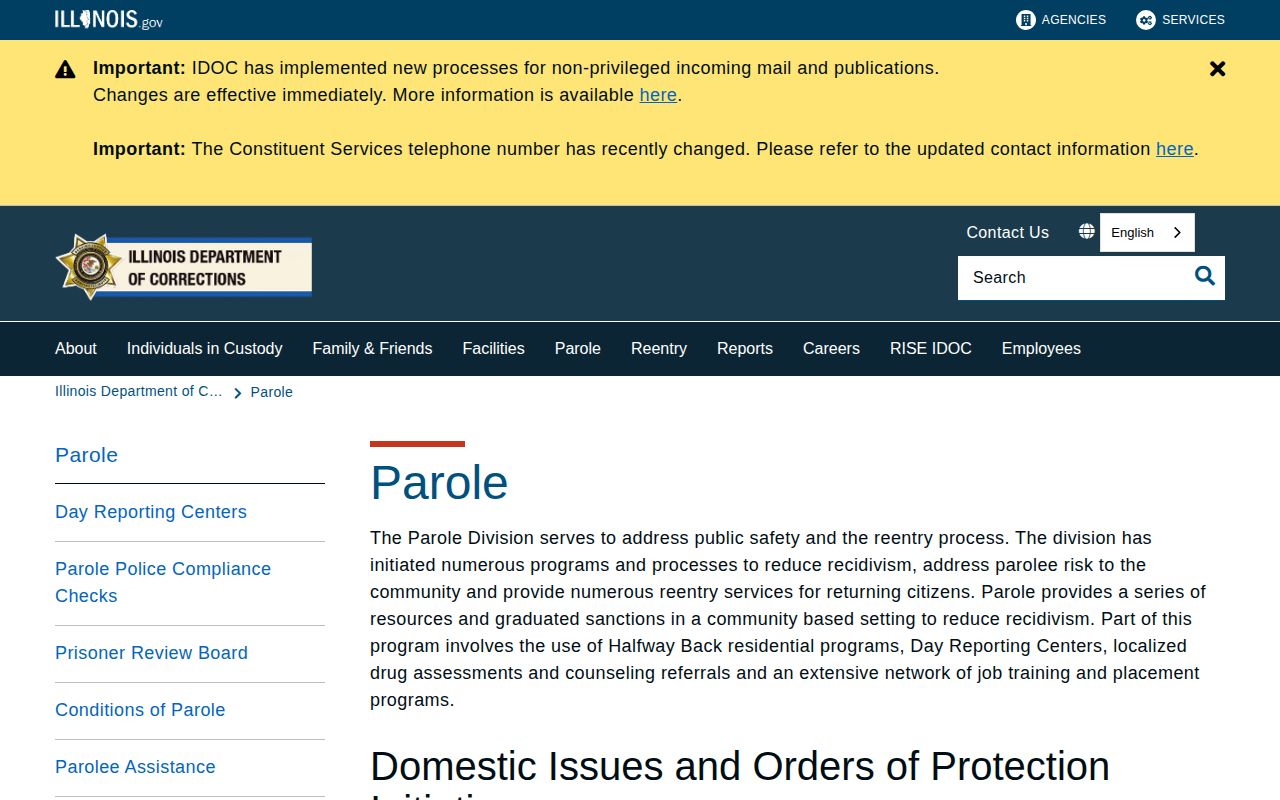
The overview identifies the state program, while individual IDOC and PRB records supply case milestones.
St. Clair Parole Hearing Limits
Not every prison release follows a discretionary hearing. The PRB monthly en-banc process addresses legacy indeterminate matters, including older crimes and C-number cases. Interviews may recur after minimum time is calculated. A majority can grant or deny parole, and a denial may carry a later reconsideration date. Calendar placement proves consideration, not release.
Youthful parole is a separate route under 730 ILCS 5/5-4.5-115. Legacy eligibility is addressed in 730 ILCS 5/3-3-3. Neither law creates one hearing date for all IDOC prisoners. Modern determinate cases generally proceed to MSR without that legacy hearing.
Compare the proper PRB result with later IDOC status. A grant can begin parole, while final discharge ends supervision. Denial, deferment, revocation, and a later-set date each mean something else. Preserve the Board's exact term.
St. Clair Pretrial Supervision
Pretrial supervision applies while charges remain pending. The Illinois Office of Statewide Pretrial Services has a St. Clair County team at the courthouse. Its record can confirm which office manages court-ordered conditions. It does not show that charges ended, a sentence was discharged, or the person is on probation.
Illinois's current framework makes “pretrial release” more accurate than assuming cash bond. The local pretrial page says supervision and GPS service are free and warns against demands for payment for release or a special program. Verify an unexpected payment request with the official team and court.
When a docket shows probation, use Adult Probation. When it shows an IDOC sentence followed by community release, use IDOC and PRB. This check prevents outside-custody statuses from being assigned to the wrong agency.
Confirming St. Clair Discharge
Discharge must be confirmed in the system that imposed supervision. For probation, start with the St. Clair County court docket. Look for the judgment, probation term, later modification, violation filing, and a final order that ends the case or supervision. Adult Probation may explain the proper contact route when a requester is legally entitled to current details. The office cannot convert a pending court entry into a final order, so the signed docket record remains essential.
For parole or MSR, compare IDOC status with any applicable PRB decision. A Last Paroled Date shows when a prison milestone occurred. It does not say that IDOC jurisdiction ended. The Projected Discharge Date is a calculated future field and can change. An early-final-discharge decision is separate. Keeping these three labels distinct prevents a released state prisoner from being described as fully discharged before the official record supports that conclusion.
Custody notifications provide another limited clue. Illinois VINELink can include current and recently released records supplied by participating agencies. The reporting agency, status, and associated date matter. A county-jail event cannot verify IDOC parole, and an IDOC event cannot prove the exact St. Clair County Jail out time. Data may lag, a facility may be offline, and a missing result is inconclusive.
When a warrant or violation appears after release, preserve the sequence. The person may first have left custody under a valid order and later become subject to arrest. The later event does not rewrite the original departure. Check the Circuit Clerk for county warrants, the responsible probation office for its process, and IDOC or PRB for state supervision proceedings. Do not infer absconder status from silence or a missing public name search.
St. Clair County's mix of county jail, local probation, statewide pretrial services, and an IDOC prison makes system identification especially important. Record the agency name, date checked, field label, and source URL. That small audit trail helps explain why a court order, IDOC profile, PRB result, and VINE alert may describe different parts of the same timeline without actually conflicting.