
Understanding St. Clair County Releases
“Released” describes the end of one custody episode, not one universal outcome. At the St. Clair County Jail, a person may leave after a judge orders pretrial release, after serving a county term, after dismissal, or through a transfer. The sheriff controls the jail custody record. The Circuit Clerk holds the legal orders and case events that may explain why the person left. A person leaving Southwestern Illinois Correctional Center follows an Illinois Department of Corrections record path instead. That person may enter mandatory supervised release, often called MSR, while remaining under IDOC authority.
The distinction matters because a transfer is not freedom from custody. A county detainee may move to IDOC, another county, federal custody, or immigration custody. Probation is a court-ordered community sentence administered locally. Parole and MSR follow prison confinement and involve state supervision. Final discharge ends the supervision phase. A dismissal resolves a charge, yet it may not reveal the minute jail staff completed release. Even death ends custody without being a community release. Each label must be preserved rather than reduced to “out.”
- Time served
- A county custody term has been completed.
- Probation
- A court sentence or supervision status handled through the county.
- MSR
- Mandatory supervised release after Illinois prison confinement.
- Discharge
- The end of the relevant sentence or supervision, depending on the record.
St. Clair County Release Paths
The record source changes with the path out of custody. For that reason, the disappearance of a name from the current jail list is only a clue. Match the sheriff's chronology with the order, receiving agency, or state record that explains the movement. The following distinctions keep a St. Clair County release search tied to the right custodian.
| Release path | What it means | Best next record |
|---|---|---|
| Pretrial release or bond | The case continues outside jail under a court order and possible conditions. | Circuit Clerk order plus sheriff out-time |
| County sentence complete | The local custody term ended through time served or sentence completion. | Sheriff custody history and sentencing record |
| Probation | The court imposed local community supervision. | Sentencing order and Adult Probation |
| IDOC transfer | County custody ended, but state prison custody began. | Mittimus, sheriff disposition, then IDOC search |
| Parole or MSR | Prison confinement ended while state supervision continues. | IDOC status, Last Paroled Date, and PRB records where relevant |
| Other-agency transfer | Another county, federal agency, or immigration authority may hold the person. | Sheriff destination and receiving-agency source |
Pretrial release is also not case dismissal. St. Clair County has a local Illinois Office of Statewide Pretrial Services team, and the agency says its supervision and GPS service are free. Its official warning about scammers is practical: no one should pay a caller who promises release or access to a “special program.” The court order and the sheriff's actual out entry remain the sound proof pair.
St. Clair County Release Record Fields
A county release record is best requested as the booking or custody history tied to a booking or master number. It should be precise enough to separate authorization from physical departure and release from transfer. A booking photo is a distinct maintained record, even when it relates to the same episode. Asking for a “full inmate file” is less useful and may draw avoidable exemptions.
| Field | What it can show |
|---|---|
| Booking or master number | The identifier tying entries to one custody episode |
| Admission date and time | When the sheriff recorded county custody |
| Actual release date and time | When physical county custody ended |
| Disposition or reason code | The recorded kind of departure, subject to the agency's code definition |
| Destination or receiving agency | Whether custody continued elsewhere, where publicly releasable |
| Court case or order | The legal event associated with release or transfer |
| Bond or pretrial entry | The release basis and related court process |
| Transfer entry | The movement to IDOC or another custodian |
Keep three dates apart: the date a judge authorized release, the actual jail or prison out-time, and the date supervision ended. Those events can be separated by hours or years. A signed order shows legal authority. It does not always prove that staff finished processing at that moment. Likewise, a photo documents an intake event rather than a later release. Exact record labels carry more meaning than a broad claim that someone is free.
Request St. Clair County Release Records
The St. Clair County Sheriff's Department supplies a FOIA request form. It accepts a detailed description and offers paper or electronic delivery choices. A narrow request should identify the person, booking or master number if known, date range, and exact records sought. Request the custody chronology, actual out-date and time, disposition code with its definition, destination or receiving agency, and the court-release or transfer entry. Ask for the booking photograph separately only when needed.
- Confirm the episode with the official current-inmate page and Circuit Clerk case information.
- Download the sheriff form and describe the booking, date range, and fields with enough detail to locate them.
- Choose electronic copies when suitable and submit through an official method listed by the sheriff.
- Keep the request date, response, any cited exemption, and any review instructions.
- Compare the produced out-time and disposition with the court or receiving-agency record.
700 N. 5th Street
Belleville, IL 62220
Jail: 618-456-7606
Nonemergency: 618-277-3505
sheriff@co.st-clair.il.us
Illinois FOIA generally gives a public body five business days for a noncommercial request and permits a statutory extension with notice. Its fee rules make the first 50 black-and-white letter or legal pages free and cap later pages at $0.15 each, subject to the statute. Electronic media may be charged at actual cost. The sheriff has not published a special booking-photo fee or verified counter hours, so do not assume the jail's round-the-clock operation means the records office is always open.
Two St. Clair Release Record Tracks
St. Clair County requires two record tracks. The Circuit Clerk handles judicial records, including release or detention orders, sentencing judgments, mittimus documents, dismissals, probation entries, warrants, and discharge events. The Clerk expressly explains that court records are not subject to ordinary Illinois FOIA. Use the court's access and copy procedures for those materials. Use sheriff FOIA for the jail's actual custody-out chronology. Mixing the two procedures can delay a request or produce the wrong proof.
The St. Clair County Circuit Clerk links local electronic case access. The statewide re:SearchIL repository may also provide documents where access rules allow. A court order may explain the legal basis for release, while the sheriff entry fixes the physical departure. This two-source match is stronger than either a roster disappearance or an uncited online claim.
The official statewide portal pictured below is a court-document route, not a jail roster. Its results must be read with the St. Clair County case and sheriff custody history.
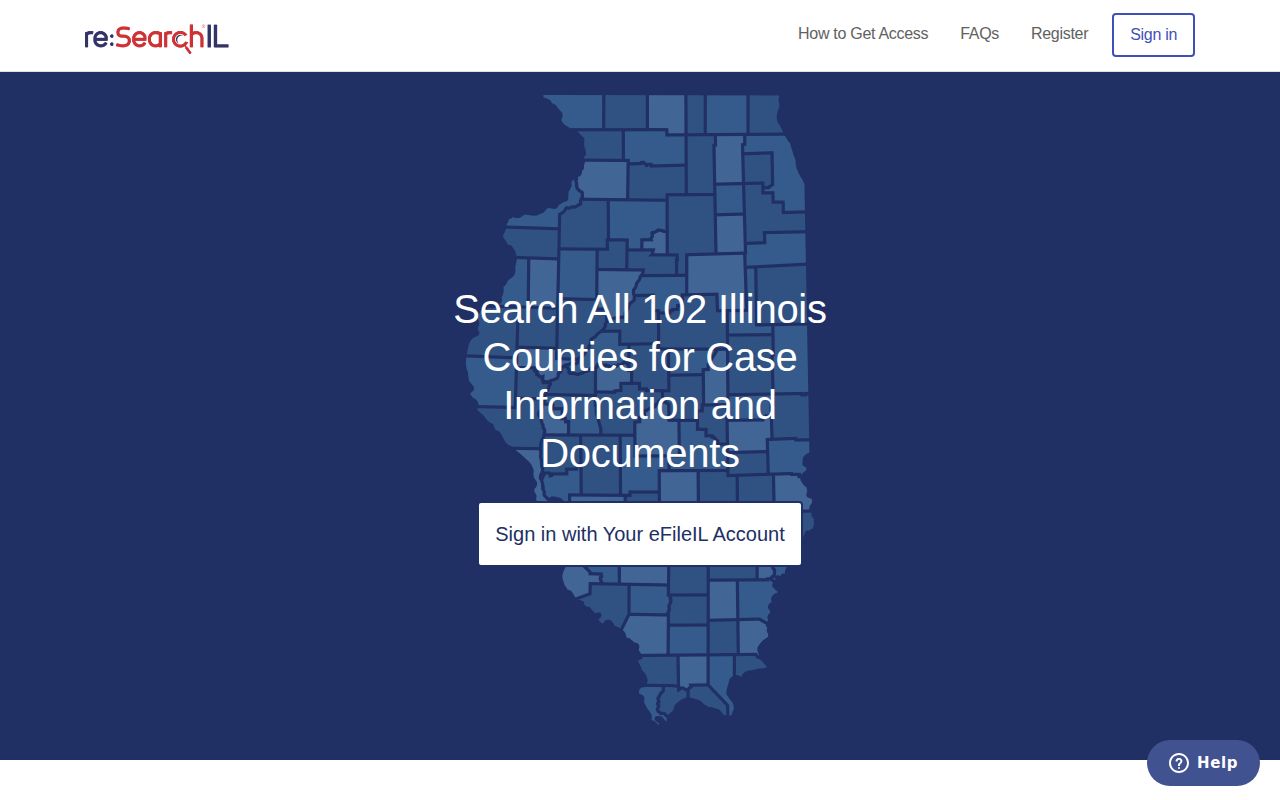
The interface can preserve the legal case trail after a current jail name disappears, subject to court access restrictions.
St. Clair Release Records After Sealing
The county does not publish one universal retention period for booking sheets, custody logs, photos, or web displays. The Illinois Local Records Act regulates disposal through approved schedules, but it does not impose one period on every record series. If an old custody history is unavailable, ask which schedule or retention authority applies. A record leaving the live roster does not mean the underlying agency record was destroyed.
Sealing and expungement affect public visibility through legal procedures. St. Clair's Clerk identifies MX sealing and expungement case types, and Illinois Courts provides approved forms. The Illinois Criminal Identification Act governs these remedies. Access can also be restricted for juvenile matters, protected personal information, safety-sensitive correctional material, and specified victim or investigatory information. A missing or withheld record should not be treated as proof of release or of any particular protected event.
Find a Released St. Clair Inmate
Begin with custody classification, not a broad name search. The sheriff page covers current St. Clair County Jail inmates. IDOC covers Illinois prison and active state legal status. The Circuit Clerk explains local court authority. VINELink carries participating-agency status and notifications. BOP, ICE, and the U.S. Marshals Service address separate federal paths. No single source proves absence from all custody.
- Check the official sheriff Corrections page. If listed, the person is currently displayed as a county inmate.
- If a known listing vanished, save the check time and look for a release, detention, sentence, dismissal, probation, or mittimus event in the local docket.
- Call the jail and request the custody history when the exact out-time, reason, or destination matters.
- If the docket indicates state prison, search IDOC by name, IDOC number, or birthdate and read every status and sentence block.
- Check VINELink for a participating-agency event, or use BOP and ICE tools when the case belongs to those systems.
- Resolve conflicts with the agency that controlled the relevant custody episode.
The sheriff says its current-inmate data refreshes hourly. It does not publish a verified Illinois St. Clair County 24-hour, 48-hour, or 72-hour release archive. For a same-day workflow, use the Jail Releases: 24 Hours process without inventing a feed. Keep observed facts separate from conclusions.
Verify Illinois St. Clair Releases
Wrong-county search results are a major local hazard. St. Clair County, Alabama publishes a tempting “48 Hour Release” roster. St. Clair County, Michigan uses inmate pages on similar-looking domains. Neither source covers Illinois. Before accepting a release page, verify the official `stclaircountyil.gov` domain, Belleville or East St. Louis geography, and the 618 telephone area code. Illinois state sources should use official state or agency domains.
A polished result from the wrong state can create a false release claim. Record the URL and jurisdiction with every search observation. If a page does not clearly connect to Illinois St. Clair County, do not use its roster, photo, booking details, or release window. This local contamination problem is why the official source chain matters more than a search engine ranking.
IDOC Search for St. Clair Releases
The Illinois Department of Corrections search is the correct route for someone sentenced to state prison, including a person who left SWICC. It accepts three independent search inputs. Open the candidate record and compare the IDOC number and available identifiers rather than trusting a name alone. Read Offender Status and Location together, then review the admission, release, discharge, and sentence blocks.
| Search field | Format and use |
|---|---|
| Last Name | Full or partial surname, with supported surname-first formats |
| IDOC Number | A state identifier such as the format K01234 |
| Birthdate | Date entry used to narrow identity |
Illinois uses the exact field label Projected Discharge Date. A record may also show Admission Date, Last Paroled Date, Parent Institution, photographs, sentence details, and `Sentence Discharged?: YES/NO`. The discharge flag belongs to one sentence count. Another count may remain active. A no-match result is not proof of release because IDOC says a completed or discharged sentence can be one reason a record is absent.
The official IDOC search wrapper pictured below leads to the embedded offender form and its state record fields.
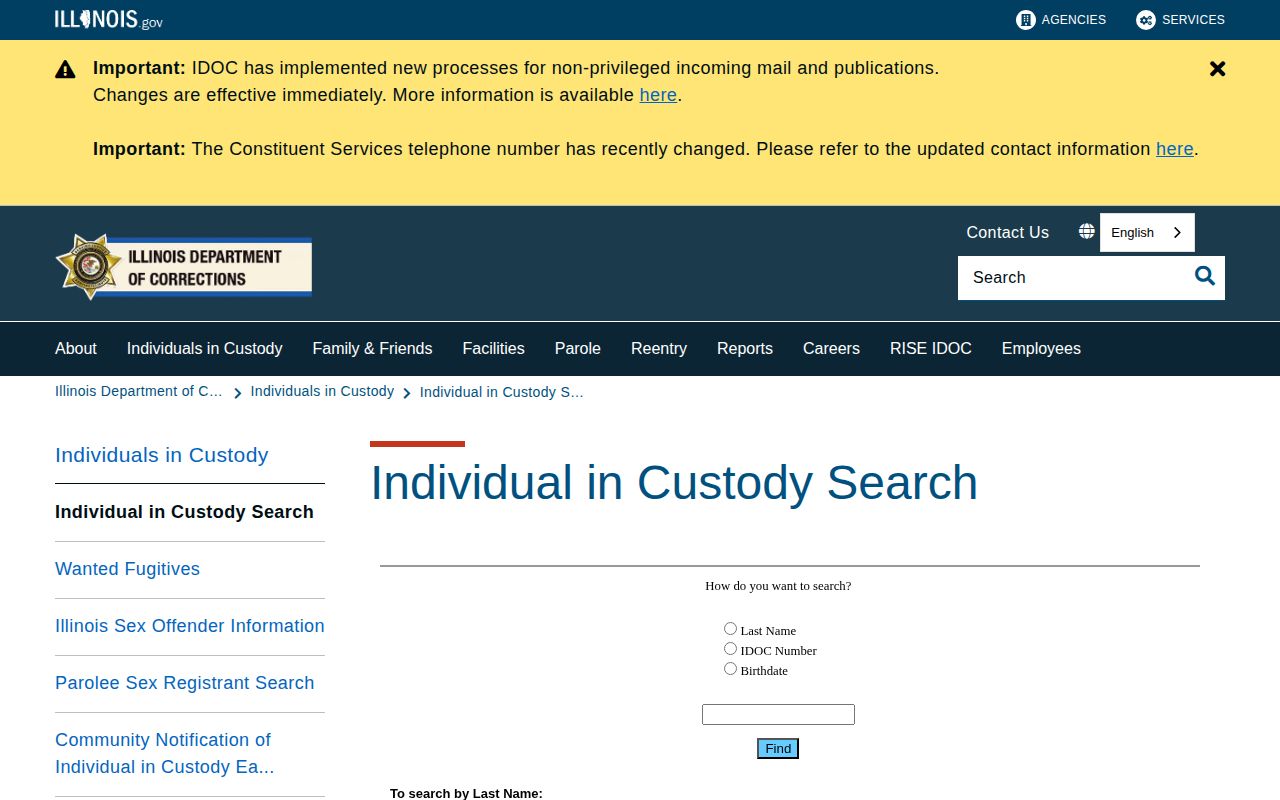
Use IDOC Public Information or its written records route when a fully discharged former record no longer appears publicly.
St. Clair Release Supervision Systems
Three community systems operate in St. Clair County. Adult Probation at 11 West Lincoln addresses court probation. The Office of Statewide Pretrial Services team works from the courthouse at 10 Public Square and handles eligible pretrial conditions. IDOC's Parole Division handles parole and MSR, while the Illinois Prisoner Review Board sets relevant conditions and decides certain hearings, revocations, and final-discharge matters. There is no verified general public statewide lookup for a supervising officer.
An active IDOC profile is often the best public clue to state supervision. Record its exact status, Last Paroled Date, Location, and Projected Discharge Date. A parole or MSR start is not final discharge. Local probation should instead be supported by the sentencing order and, where the requester is entitled to information, Adult Probation. The distinctions and office routes are covered in the Probation & Parole record page.
St. Clair Release Reentry Resources
The St. Clair County Mental Health Board identifies funded services, and the local Offender Success initiative reports 143 returning county residents served across the displayed FY23 and FY24 figures. These resources can help with treatment, identification, transportation, family support, and supervision coordination. Participation does not prove that a particular person was released, completed a program, or holds a given status. Verify custody through the controlling agency first.
SWICC's treatment and reentry role is also local context, not an individual release record. A person may transfer from SWICC to another IDOC site, enter MSR, or reach final discharge. The IDOC profile and records office establish those milestones. A program page cannot replace them.
Getting Home After St. Clair Release
Metro's official Illinois map labels St Clair County Jail, and the Belleville Transit Center connects MetroLink with bus service, including Route 16 at the center. These facts support trip planning for a released person or family. They do not establish the jail's release door, walking time, waiting area, taxi policy, release schedule, or any jail-provided fare.
The sheriff publishes no verified release schedule. Do not promise morning, evening, weekday, weekend, or holiday timing. Confirm physical release before anyone travels, and use the jail information line for current instructions. A court order may exist while jail processing or another hold remains unresolved.
St. Clair Federal Release Checks
Illinois VINE, accessed through VINELink, supplies participating-agency custody events and optional notifications. Search one person, confirm the reporting agency, and read the event wording and date. A VINE “released” event shows that the reporting episode ended. It does not rule out transfer unless the event makes the destination clear. The service can lag or omit a nonparticipating or blocked record.
For a federal prison case, the BOP inmate locator can show Location and Release Date. “Released” or “Not in BOP Custody” does not exclude state, local, immigration, or supervised-release obligations. ICE's locator is current-location oriented, not a historical release archive. U.S. Marshals pretrial custody may require the federal docket, the actual contract holding facility, and the Southern District office because no public USMS historical release locator exists.
The BOP locator shown below is useful only after federal custody has been correctly identified.
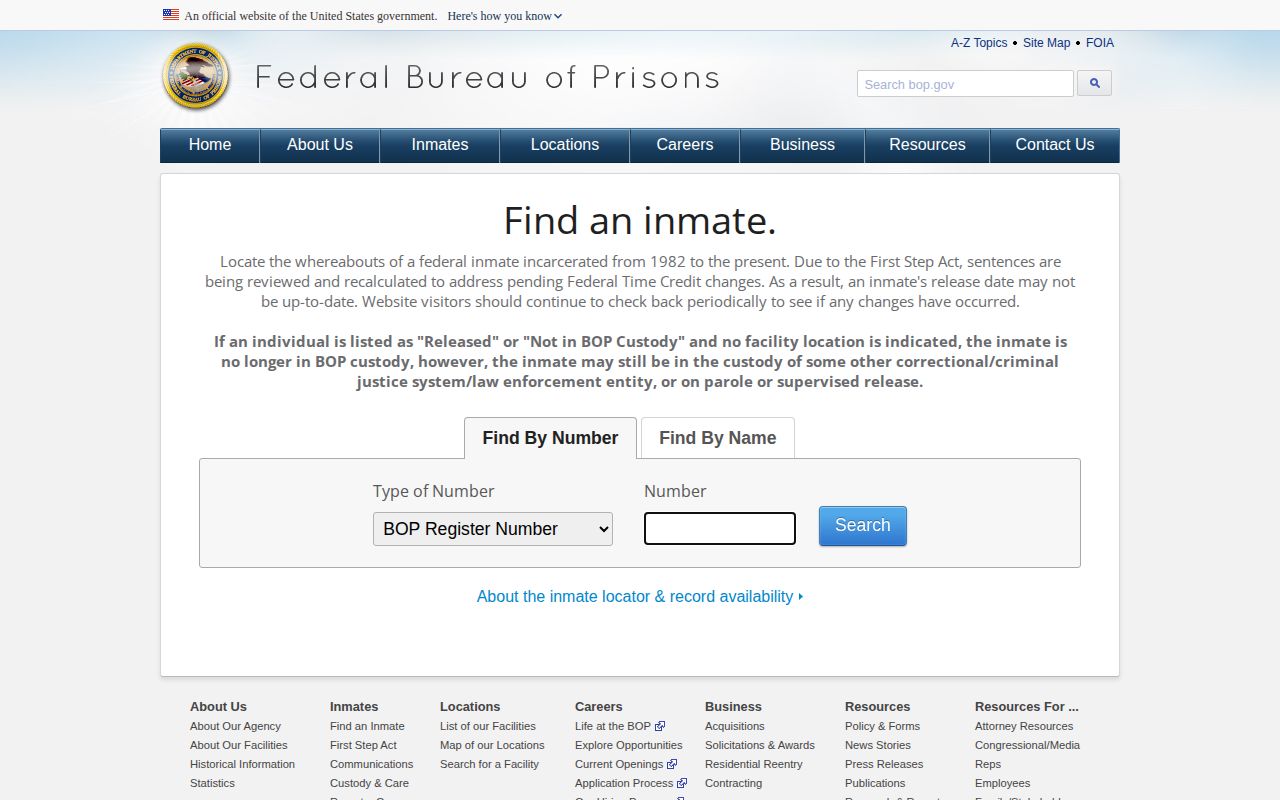
Read its release label with the federal docket and any known state, county, or immigration record.
St. Clair Released or Still Held
Each system answers a limited question. A current roster establishes a present display, while a release history records the end and disposition of a past custody episode. Court and notification tools add legal or event context. Comparing their scope prevents a transfer from being reported as community release.
| System | Best use | Key limit |
|---|---|---|
| St. Clair sheriff current search | See whether the person is presently listed at the county jail | No verified release archive or reason field |
| Sheriff custody history | Confirm actual county out-time and disposition | May require a focused request |
| Circuit Clerk | Find the legal order, sentence, dismissal, probation, or mittimus | An order time may precede physical release |
| IDOC offender search | Check state custody, parole/MSR clues, and discharge fields | A fully discharged record may no longer match |
| VINELink | Receive a participating agency's status event | Feed coverage and timing vary |
| BOP or ICE | Check the applicable federal system | Neither proves absence from every other custody system |
St. Clair County Release Facilities
St. Clair County Jail is the adult county facility and uses the sheriff, court, and custody-history path. St. Clair County Juvenile Detention Center is separate and confidential; only an authorized person should use juvenile court or probation channels. Southwestern Illinois Correctional Center is an IDOC minimum-security state prison, so release, MSR, transfer, and discharge are state records. Southwestern Illinois Work Camp is an IDOC subfacility within the SWICC perimeter and uses the same state verification system.
The county jail dates to 1970 and SWICC opened in 1995. Their records are not interchangeable even though both facilities sit within St. Clair County. The sheriff tracks Belleville county custody. IDOC tracks the East St. Louis prison system. A movement between facilities may be a transfer, while leaving prison may begin MSR rather than end state jurisdiction.