
Projected vs Actual Release Date
A projected date is a calculation, not a promise of departure at a set hour. A pretrial detainee may have no sentence from which to calculate a date. A sentenced county inmate relies on the court order and jail calculation. A state prisoner relies on IDOC's sentence record.
A transfer to another agency is not community release. Pair the date with status and destination records.
How to Find a St. Clair County Inmate's Projected Release
First identify whether St. Clair County Jail or IDOC controls the sentence. The sheriff publishes no projected-release calculator.
- Check the court docket for the sentence, custody date, and amendments.
- For an IDOC case, use the IDOC offender search.
- Read every sentencing block and the exact Projected Discharge Date.
- For a county sentence, ask jail records staff to confirm the court-based calculation.
- Use the release verification path to confirm what happened afterward.
An IDOC result may show INELIGIBLE. Preserve that label rather than guessing.
Good-Time Credit and How Release Dates Are Computed
Illinois credit is governed by 730 ILCS 5/3-6-3, read with 730 ILCS 5/5-4.5-100. There is no universal 85-percent rule. Murder may require 100 percent. Some listed offenses limit credit to 4.5 days per month, commonly called 85 percent, while other listed crimes may use a 75-percent framework. Effective dates matter.
The IDOC FAQ says earned-credit eligibility depends on custody time, offense exclusions, conduct, assessments, programs, and treatment. Eligibility is not an entitlement. Never estimate an out-date from a percentage alone.
Why a Projected Release Changes
A correct date today can move when relevant information changes.
| Factor | Effect |
|---|---|
| Credit award or restoration | May move earlier |
| Credit loss or absence | May move later |
| Court amendment | Changes the sentence structure |
| Concurrent or consecutive terms | Changes the total calculation |
| Detainer or hold | May change destination |
| MSR | Starts supervision, not final discharge |
Confirming a Release Date
Near the date, recheck IDOC and the proper court or jail record. Illinois VINELink can send participating-agency alerts. Follow the VINELink inmate search, then verify an alert because data can lag and another agency may assume custody.
IDOC's official credit explanation is shown below.
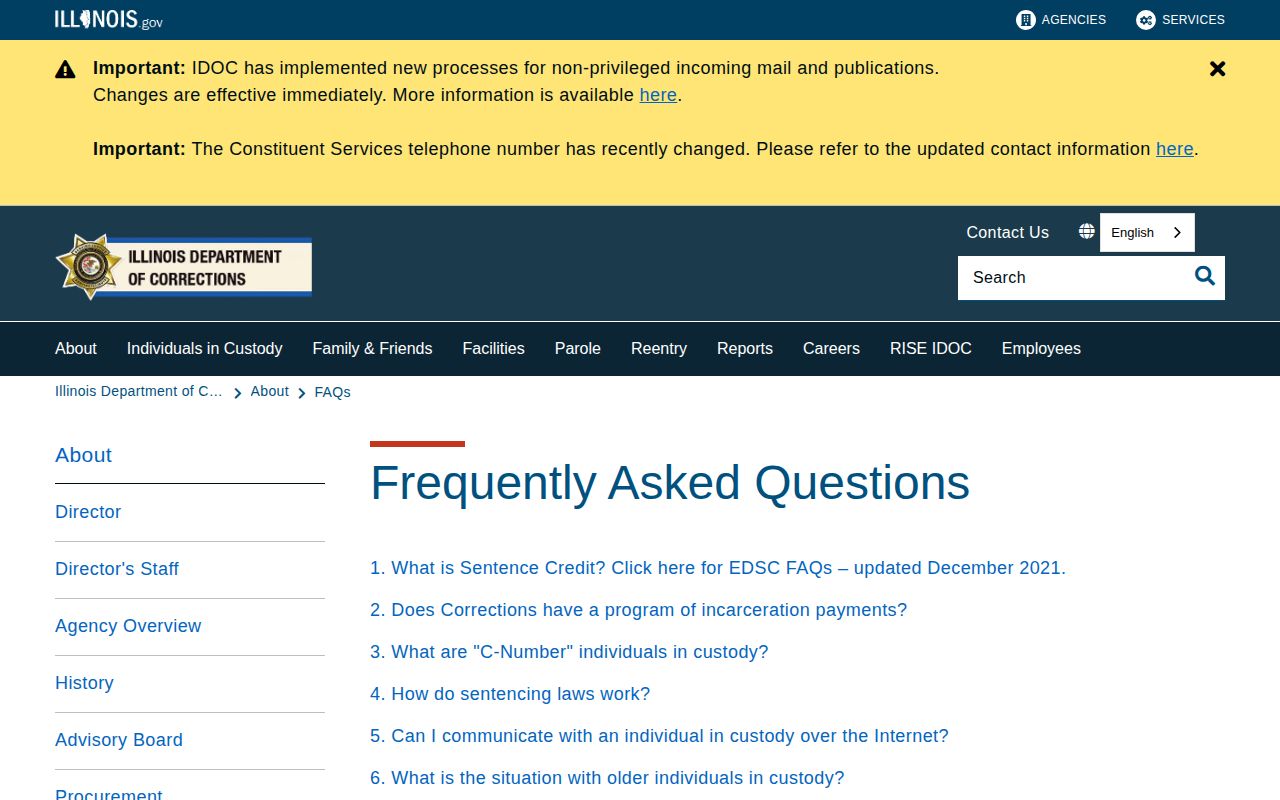
The explanation cannot calculate an individual date without the full record.
St. Clair IDOC Date Fields
The IDOC search accepts last name, IDOC number, or birthdate. Results can show admission date, Last Paroled Date, Projected Discharge Date, location, offender status, and separate sentencing blocks. None should replace another. Last Paroled Date concerns a move from prison into supervision. Projected Discharge Date concerns the calculated end of IDOC jurisdiction.
| Field | Meaning | Limit |
|---|---|---|
| Offender Status | Current IDOC legal status | Read with location |
| Last Paroled Date | Supervised-release milestone | Not final discharge |
| Projected Discharge Date | Calculated discharge | May change |
| Sentence Discharged | Status of one count | Another count may remain active |
A no-match result is inconclusive. Completion and discharge can explain an unavailable record. Confirm an older case through court and IDOC records channels.
St. Clair County Sentence Dates
A county-jail sentence is controlled by the judgment and applicable credit. The Circuit Clerk docket may show sentence, custody credit, amendment, dismissal, warrant, or transfer order. It does not provide the moment jail staff finish physical discharge. The sheriff's custody history supplies that operational fact.
Pretrial custody credit and eligible program credit can affect a calculation. Consecutive and concurrent treatment also changes arithmetic. A charge list is not enough. Obtain the signed order or minute entry, then ask jail records staff how it was applied. If the court changes the order, use the new calculation.
Note: St. Clair County publishes no online county-jail calculator, fixed weekend-release rule, or guaranteed departure hour in the verified sources.
St. Clair Release Destinations
A projected date does not always answer where someone goes. A person leaving the county jail may enter IDOC, another jail, federal custody, or immigration custody. Someone leaving Southwestern Illinois Correctional Center may transfer within IDOC or begin MSR. Each event needs the receiving or supervising agency's record.
A detainer may change the destination even if the original sentence date stays the same. Court orders, new warrants, credit loss, absence, and revised sentence data can change the timeline. Ask the custodian which factor changed instead of calculating from a public charge label.
For federal custody, use the BOP locator. For immigration detention, use the ICE locator. Neither is a historical St. Clair release archive, and one system cannot prove freedom from all other custody.
Proving the Actual Release
After the projected date, verify the actual event. For the county jail, request the actual out date and time, disposition or destination code, and transfer agency when maintained and releasable. Compare custody history with the Circuit Clerk order. For IDOC, recheck status, location, parole information, and sentence-discharge fields.
VINELink may include current and recently released people from participating agencies. An alert should prompt verification, not replace it. A release label means the reporting custody event ended, but it may not show an immediate transfer.
The strongest proof pairs the authority for release with the operational custody record. A future date alone is weaker because credit, court action, and holds can intervene. An old date without a compatible status is also incomplete.
Illinois Credit Calculation Details
IDOC Directive 01.07.400 describes sentence calculation for determinate sentences, including projected release and mandatory release calculations. Statutory credit can change a projected date. Loss of time through absence can affect a mandatory calculation. The directive provides an administrative framework, but the current statutes and complete individual sentence still control the result. A public reader should not reproduce IDOC arithmetic from a short docket summary.
Earned credit is discretionary when the governing law makes a person eligible. IDOC considers assessment results, offense circumstances, forcible-felony history, institutional behavior, program commitment, and required treatment. An eligible person may receive no award, or an award can post after an earlier profile was viewed. If credit changes projected parole timing, IDOC says the individual is notified and the profile is adjusted. A saved screenshot is therefore evidence of the field at that time, not a permanent guarantee.
Truth-in-sentencing percentages also need care. The commonly repeated 85-percent figure applies only where the statute limits credit to 4.5 days per month. Other enumerated offenses may follow a 75-percent structure, murder can be subject to 100 percent, and other sentences follow the credit provisions that fit the offense and date. Enhancements, multiple cases, and consecutive terms can make a single percentage misleading even when it is correctly stated for one count.
St. Clair Court Date Review
The St. Clair Circuit Clerk record is the durable source for judicial action. Relevant entries can include detention or release orders, sentencing, mittimus, dismissal, probation, sentence credit, warrant, and discharge. A mittimus is the court document directing custody or commitment. A judicial release order establishes authority, while the sheriff's later custody record establishes when staff completed the physical departure.
Court-record access follows clerk procedures, not ordinary county FOIA. Search by the correct case and compare document dates, because a later order can amend the earlier sentence. If public electronic access does not show the needed document, contact the clerk about the authorized access route. Do not ask the sheriff to interpret the judge's sentence, and do not ask the clerk to certify the jail's actual out time.
A person with pending charges may receive pretrial release and supervision without any projected sentence date. The local Office of Statewide Pretrial Services record can help identify the supervision channel, but it does not prove dismissal or discharge. If the court later imposes probation, that is a new status. If it imposes an IDOC sentence, the state calculation becomes the relevant projected-date source.
Projected Date Verification Log
Record the exact field label, date viewed, agency, and case or IDOC number used. Then note whether the person was in county custody, IDOC custody, on MSR, or finally discharged. This simple chronology prevents a projected date copied on one day from being presented later as an actual release.
Check again near the expected milestone and after it passes. If the field moved, look for sentence credit, disciplinary action, court amendment, a new count, or corrected custody data. If the person left one facility but remains listed under another location, treat that as a transfer until the official status says otherwise. If a hold appears, identify its agency before describing the destination.
When records disagree, prioritize the agency responsible for each fact. The court controls its order. The sheriff controls county custody history. IDOC controls state sentence calculations and status. PRB controls its hearing decisions. VINELink repeats participating-agency events and is best used as notice. Compatible records across those roles provide a far stronger answer than any lone estimated date.
St. Clair Date Questions
A family member may see several dates and reasonably ask which one controls. Start by naming the event. A court date is a hearing or filing date. A custody date marks the start credited to a sentence. A projected discharge date is IDOC's calculated estimate. A Last Paroled Date marks a past supervision milestone. An actual out date records physical departure from a facility. Final discharge ends the remaining legal supervision. Writing the label beside each date often resolves an apparent conflict.
Do not assume that a scheduled weekend, holiday, or courthouse closure forces a specific release practice. The verified St. Clair sources publish no general weekend-release schedule. Operational processing can depend on when the jail receives and verifies an order, whether another hold exists, and which agency is responsible. Ask the jail about the individual completed event rather than promising an adjusted day.
If the date concerns Southwestern Illinois Correctional Center or its work camp, use IDOC even though both are geographically in St. Clair County. The sheriff does not calculate an IDOC sentence. Conversely, IDOC does not calculate a short county-jail term imposed and served locally. Geographic proximity does not merge the record systems.
Keep copies of the result and later confirmation when the timing matters for personal planning, notification, family contact, transportation, or a court process. A dated copy shows what the agency reported at that moment. It should still be described as projected until an operational release or transfer record confirms the event.